Natural gas and propane are both odorized with a chemical called mercaptan that smells like rotten eggs, specifically so leaks can be detected before they reach ignition levels. If you smell that odor inside your home, garage, or near an appliance, treat it as a life-safety emergency — not a plumbing inconvenience.
Step 1: Leave the Building Immediately
Get everyone (including pets) out. Do not use garage door openers, do not switch lights on or off, do not unplug appliances. Even the small electrical spark from a light switch can ignite gas. Don't stop to gather belongings.
Step 2: Call From a Safe Distance
Once outside and at least 50 feet from the house, call us at (831) 290-4327 for licensed gas response, and Atmos Energy at 1-866-322-8667 to report the leak. Both numbers are 24/7.
Step 3: Do Not Re-Enter Until Cleared
Don't go back inside for phones, pets already outside, or valuables. Emergency responders and plumbers will tell you when it's safe to re-enter.
Step 4: Ventilate Only If Instructed
If a first responder or licensed plumber tells you to open windows, do so carefully. Otherwise leave the building sealed as-is until we arrive.
How We Handle a Gas Call
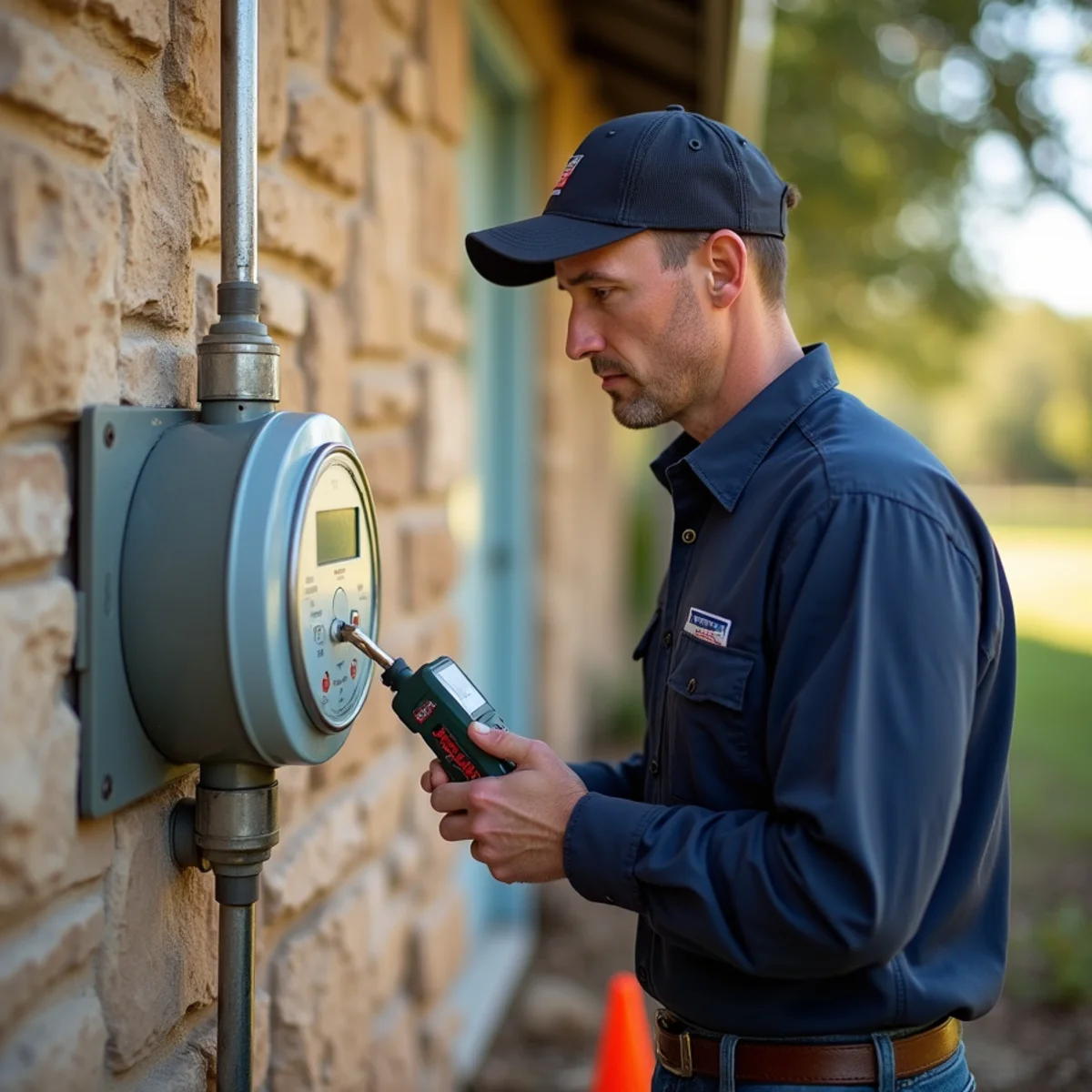
On arrival we shut the gas at the meter, ventilate, and use combustible-gas indicators (CGI) to detect the leak location. Soap-bubble testing on fittings and CSST joints pinpoints the exact leak. We repair with black iron or approved CSST, properly bond to the electrical ground, pressure-test at 3 PSI for the code-required minimum time, and restore service. Every gas repair is permitted through the City of Leander or Williamson County.
Signs of a Slow Gas Leak
- Occasional rotten-egg smell that comes and goes
- Dead vegetation in a straight line across the yard
- Higher-than-normal Atmos Energy bill without any usage change
- Hissing sound near a gas appliance or meter
- Yellow (not blue) flames on a gas cooktop or water heater
How Natural Gas Leaks Actually Happen in Central Texas Homes
Gas leaks in a Leander home come from a limited set of failure points: a corroded flex connector at the water heater or range (most common — flex is a wear part and dies at 15-20 years); a loose fitting behind a range that gets bumped during move-in; a cracked yellow CSST run struck by a nail or screw during a remodel; a corroded buried service riser where the gas line comes up out of the ground; or a lightning-struck CSST run that wasn't properly bonded to the electrical system (a real risk on 2000s-2010s installs before the current NEC bonding requirement).
Each failure point has a signature: a rotten-egg smell near an appliance points at a flex or fitting; a smell outside near the meter points at the service riser; a hissing sound in a wall points at a struck CSST run. Our combustible-gas detector confirms location in seconds — no guessing, no soapy water on-the-fly.
The Legal and Insurance Consequences of DIY Gas Work in Texas
Texas law is unambiguous on this: residential natural gas work requires a licensed Responsible Master Plumber with an active natural-gas or LP endorsement — not a handyman, not a general contractor, not a homeowner with a wrench. Unpermitted gas work voids most homeowners insurance policies. If a future gas leak causes a fire, an insurer that discovers unpermitted DIY gas work has grounds to deny the claim entirely.
The permit and inspection process is not bureaucratic gatekeeping — it's the paperwork trail that protects the homeowner if something ever goes wrong. Our permit + inspection closeout on every gas job is the reason insurance carriers cover the resulting installation.
What Happens After You Report a Gas Smell in Leander
The sequence: (1) you and everyone in the house leave — with pets, no light switches, no phones inside the house; (2) call us from outside at (831) 290-4327 — a licensed plumber picks up 24/7; (3) if the smell is strong or persistent, also call 911 and the utility (Atmos, CenterPoint depending on your service); (4) we dispatch a Master Plumber to your Leander address, usually inside 60 minutes; (5) we sweep with a combustible-gas detector, isolate at the meter, repair the failed component, pressure-test the run, and pull a permit under our RMP license; (6) City of Leander inspector closes the record and you get the paperwork.
Need help right now?
Call (831) 290-4327 — a licensed plumber picks up 24/7.