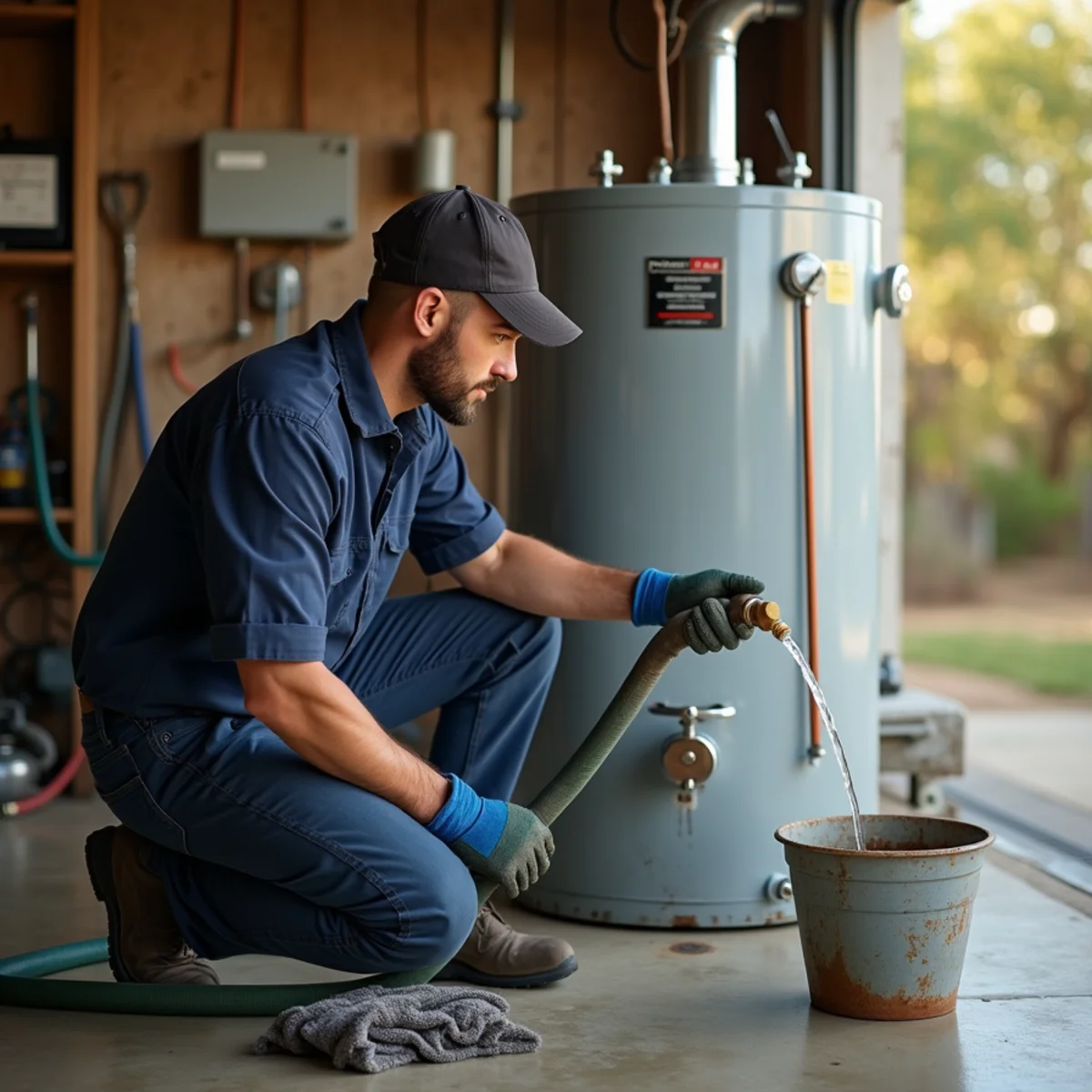
Every gallon of water you heat in Leander leaves behind calcium and magnesium — a slow accumulation of hard scale on the burner and inside the tank. That scale is why 10-year Leander water heaters usually only make it 6–9. The fix is dead simple and takes about 45 minutes.
How Often to Flush
- With no softener: annually, ideally in fall before heavy winter demand
- With a softener: every 18–24 months
- Tankless without softener: every 6 months (mandatory to preserve warranty)
- Tankless with softener: every 12–18 months
DIY Flush (Standard Tank Heater)
- Turn off gas or electricity to the water heater
- Turn off the cold supply valve above the heater
- Attach a garden hose to the drain valve at the bottom of the tank; run it to a driveway or a large drain
- Open the hot side at the nearest sink to let air in
- Open the drain valve; let the tank fully drain (30 minutes)
- Briefly re-open the cold supply for 60 seconds to flush any sediment
- Close the drain, close the hot sink faucet, open the cold supply fully, and refill
- Once water flows freely at all hot faucets, turn gas/electric back on
When to Call a Pro Instead
If the drain valve won't open (common on 5+ year units), if the tank pops loudly, or if you're not sure — call us. A professional flush is a flat fee, includes a T&P valve test and anode-rod inspection, and often catches issues that would fail within 12 months if left alone.
Tankless Descaling
Tankless units require a pump-and-vinegar descaling procedure that takes about 60 minutes. It's more involved than a tank flush, and skipping it will void your manufacturer warranty. Most homeowners have us do this annually as part of a maintenance visit.
Why Central Texas Water Heaters Need Annual Flushing
Every gallon of Leander water carries 15-25 grains per gallon of dissolved calcium and magnesium. When that water heats up in your tank, some of the mineral load precipitates out as scale — settling on the bottom of the tank and coating the heating element (electric) or the base plate (gas). Over a year, an unsoftened Leander tank accumulates 3-8 inches of scale sludge on the bottom.
The consequences: reduced usable capacity (10-30% less hot water than the tank should deliver), longer recovery times, higher gas or electric bills to heat through the scale insulation layer, popping and rumbling noises during heat cycles, and shortened tank life (a 10-year-rated tank typically dies at 6-9 years in unsoftened Leander water).
The DIY Annual Flush Procedure
- Turn off the gas or electric supply to the water heater. Wait 30 minutes for the water inside to cool.
- Turn off the cold-water inlet valve on top of the heater.
- Attach a standard garden hose to the drain valve at the bottom of the tank. Route the other end to a floor drain, exterior downspout, or a large bucket you can empty repeatedly.
- Open the drain valve and open a hot-water faucet upstairs to break the vacuum and allow the tank to drain.
- Watch the drain water — the first minutes will run rusty brown from scale. Let it run until the water runs clear (typically 5-15 minutes on a heavily-scaled tank).
- Close the drain valve, close the upstairs faucet, and turn the cold-water inlet back on. Let the tank refill (10-20 minutes).
- Turn the gas or electric supply back on, wait for heat cycle to complete, and check the T&P discharge for any drip.
When to Call a Plumber Instead of DIY
Skip the DIY flush and call us when: (1) the drain valve doesn't open (common on 5+ year unflushed tanks — the scale has cemented it shut); (2) the water won't stop draining after the valve is closed (drain valve washer has failed); (3) you notice a leak from the tank body during or after the flush; (4) the tank is over 10 years old (a flush on a dying tank can accelerate the failure — better to plan a replacement); or (5) you have a tankless heater (that's a different descaling procedure using a submersible pump and vinegar or descaling solution).
Need help right now?
Call (831) 290-4327 — a licensed plumber picks up 24/7.