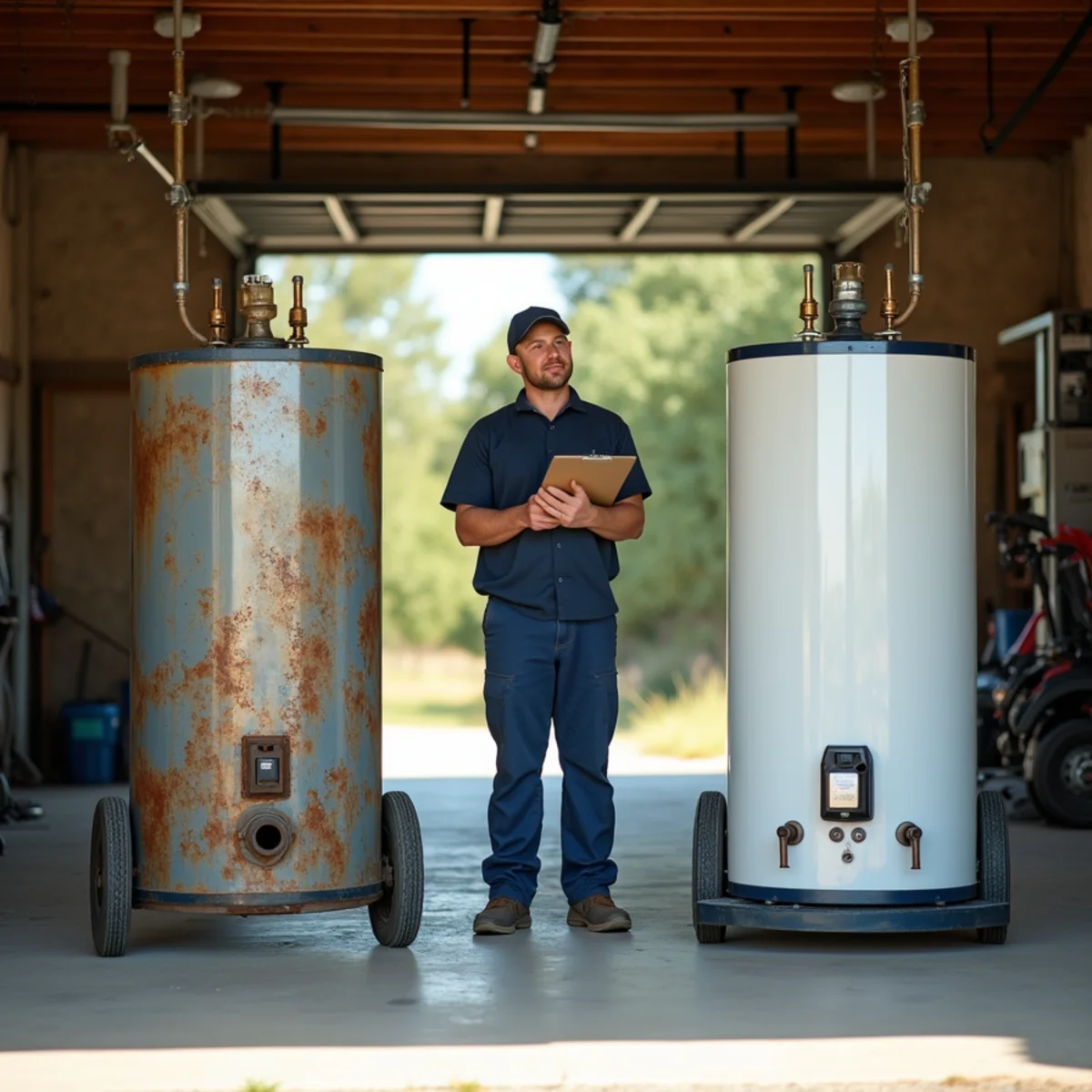
The single most common question a homeowner asks when the water heater fails: repair it or replace it? The right answer depends on three factors — age, failure mode, and Leander's water hardness. Here's the framework we use every day.
Question 1: How Old Is It?
Decode the serial number on the tank sticker. Most tank heaters have a date code buried in the serial number (Rheem uses the first four digits: week and year; A. O. Smith uses a similar format). If your heater is under 6 years old in Leander, repair almost always makes sense. Between 6 and 10 years, it's a judgment call. Past 10 years, replace.
Central Texas has a hard-water penalty on this age math: Leander water is 15–25 grains per gallon of hardness, and tank heaters here typically fail 3–5 years earlier than the sticker date suggests. If you have never had a softener, mentally subtract 3 years from your heater's age.
Question 2: What's the Failure Mode?
- Leaking tank body — REPLACE. A rusted-through tank cannot be safely repaired.
- T&P valve dripping — REPAIR (single-part swap).
- Pilot won't stay lit — REPAIR (thermocouple or gas valve, both under $250 installed).
- Popping/rumbling from tank — POSSIBLE REPAIR via flush; heavy scale = plan to replace.
- Rust-colored hot water only — anode rod failed and tank interior is oxidizing; replace within 12 months.
- Tankless throwing error codes — often descaling + repair; 20-year units rarely need replacement.
Question 3: What Would Replacement Cost You Now vs. Later?
If a $600 repair buys you 12 more months on a 10-year-old tank that will need replacement anyway, and replacement is $2,400, you spent $600 to defer $2,400 by a year — a rough 25% cost of capital. That math often doesn't work. Add tankless conversion or a softener install to the replacement job and it often makes more sense to just replace now.
When to Convert to Tankless
Convert to tankless if: (a) your home has 3+ bathrooms, (b) you have gas already at the water heater location, (c) you plan to stay 7+ years, and (d) you're willing to install a softener at the same time (mandatory to hit tankless warranty). We give an honest recommendation with both options priced.
Water Heater Cost Bands in Leander (2026)
For rough planning: standard 50-gallon gas tank replacement runs one range; 75-gallon or attic-install premium; tankless conversion with a softener install runs the highest. We quote flat-rate in writing after a walkthrough — never on the phone.
The Leander Water Heater Age-Out Curve
A standard tank water heater is nameplate-rated for 10 years. In Leander's 15-25 grain hard water, without a softener, that rating routinely compresses to 6-9 years. With a softener installed within the first year of the tank's life, expect 10-14 years. That means a 12-year-old tank in a softened home is on borrowed time; the same age tank in an unsoftened Anderson Mill or Cedar Park home is well past life expectancy.
The failure mode matters as much as the age. Tank tops that show a small drip usually have a failing internal glass lining — that's terminal. A failing thermostat, element, or T&P valve is a $200-$400 repair on an otherwise sound tank. A completely flooded pan under an older tank is a full-failure event — replace, don't repair.
The Repair-vs-Replace Decision Tree
Ask three questions in order:
- How old is the tank? Under 6 years = repair candidate. 6-10 years = decide on cost. Over 10 years = replacement candidate.
- What failed? Element, thermostat, T&P valve, expansion tank = repair. Internal tank lining, bottom rust, corroded gas valve on an older unit = replace.
- Is a softener installed? If yes, tank life is 10-14 years and repair math works longer. If no, the next tank you install should include a softener or expect the same 6-9 year cycle again.
Tank vs. Tankless — When Each Wins
Tankless wins on: gas homes with existing gas capacity, high-flow bath demand (multiple showers, big soaker tubs), space-constrained closets or garages, and homes with a softener already installed. Tank wins on: electric homes without gas, budget-constrained replacements, and homes without a softener (tankless burners scale even faster than tank elements). Every replacement quote we write compares the two side by side so you can decide, not us.
Need help right now?
Call (831) 290-4327 — a licensed plumber picks up 24/7.